
Indonesia and Vietnam Strengthen Radio Spectrum and Satellite Cooperation to Protect Digital Connectivity
Overview: Why Satellite Coordination Requires Careful Radio Spectrum Planning
Behind every reliable internet connection and mobile signal sits a quieter negotiation: countries agreeing on how to share orbital space and radio frequencies without interfering with one another. It’s not the kind of work that makes headlines, but it’s the reason satellite-based services keep running smoothly across borders. Indonesia and Vietnam have just completed the third round of talks on this exact issue, hosted by Indonesia’s Ministry of Communication and Digital Affairs through the directorate responsible for spectrum and satellite orbit planning.
The two countries aren’t strangers to this process. Satellite coordination between neighboring nations is a recurring requirement under international telecommunications rules, and this latest meeting builds on two earlier rounds of discussion. That continuity matters: as more satellites go up and more spectrum gets allocated across Southeast Asia, the margin for error narrows, making sustained, structured coordination less of a formality and more of an operational necessity.
Third Indonesia–Vietnam Satellite Coordination Meeting Held in Bandung
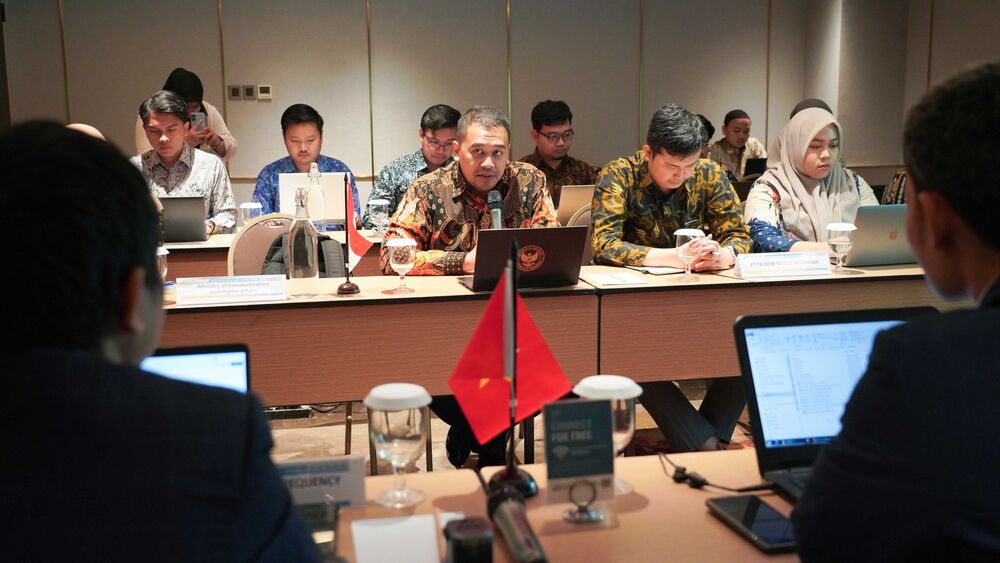
From July 13 to 16, technical delegations from both countries met in Bandung, West Java, to align their use of satellite orbits and radio frequencies under rules set by the International Telecommunication Union (ITU). The objective was straightforward but consequential: prevent signal interference between the two countries’ satellite networks, so that communication services continue running reliably for the public.
The discussions covered the technical specifics of orbital slot usage and frequency assignment — the kind of granular engineering work that rarely gets public attention but directly determines whether satellite services stay stable or start degrading. Delegates worked through how each country’s satellite operations could coexist without disrupting the other’s signal quality, a process that requires close technical alignment rather than broad diplomatic gestures.
This marked the third meeting in an ongoing series, underscoring how central spectrum planning has become as satellite activity across the region continues to expand. With more countries launching satellites and expanding coverage, meetings like this are likely to become more frequent, not less, as the shared resource gets busier.
Officials Highlight Shared Responsibility Over Limited Spectrum Resources
Adis Alifiawan, Director of Radio Frequency Spectrum and Satellite Orbit Arrangement and Digital Infrastructure Standardization, described orbital positions and radio frequencies as finite resources that many countries must share, making coordination a necessity rather than a formality. When managed well, he noted, this kind of cooperation allows both countries to use the resource efficiently and equitably — a point that applies well beyond just these two nations, given how many countries draw on the same limited orbital and spectrum space.
He also connected the talks to broader outcomes: dependable connectivity, economic growth, and communication during emergencies all rest on this kind of groundwork. When satellite coordination breaks down, the effects aren’t abstract — they show up as dropped signals, degraded service, and slower emergency response during exactly the moments when reliable communication matters most.
Indonesia, as host, positioned the meeting as an open and collaborative process, with both countries expected to reach agreements that support their satellite networks and strengthen bilateral ties. Officials framed the outcome as relevant beyond the two countries involved, tying it to ASEAN’s broader connectivity goals — a signal that this kind of bilateral groundwork is increasingly viewed as regional infrastructure, not just a two-country arrangement.
Key Takeaways
- Spectrum allocation is an ongoing negotiation, not a fixed arrangement. Meetings like this one actively shape how frequency is divided between countries
- Interference management is likely to draw more scrutiny, not less. As satellite traffic grows across the region, certification reviews for radio-dependent IoT and telecom devices may become more rigorous.
Not Sure Where to Start?
Request a free initial consultation or product assessment.
Our experts are here to help.