
IEC 62443 Certified? Why That Still Doesn’t Mean You’re CRA Compliant
One of the most common questions in the realm of cybersecurity compliance, particularly concerning the EU Cyber Resilience Act (CRA), is whether existing IEC 62443 certification automatically translates to CRA compliance. The short answer is: not necessarily.
While IEC 62443 is a widely referenced cybersecurity framework, it’s crucial to understand that it should not be confused with CRA compliance itself. This article delves into the nuances of their relationship, highlighting why organizations need a distinct approach to CRA.
Why Are IEC 62443 and CRA Frequently Discussed Together?
The primary reason for their frequent association stems from the fact that CRA Harmonized Standards are still under development1. Consequently, manufacturers preparing for CRA compliance often look to established cybersecurity standards, technical guidelines, and industry best practices as supporting references. Common examples include:
- IEC 62443-4-1 / 4-2
- NIST Secure Software Development Framework (SSDF)
- BSI Technical Guidelines (such as the TR-03183 series)
- FIRST PSIRT Framework
- ISO/IEC 29147
- ISO/IEC 30111
These documents offer invaluable guidance for implementing secure development processes, vulnerability handling mechanisms, security update management, product security controls, and organizational governance practices. However, it’s important to note that none of them individually defines CRA compliance.
The Most Common Misconception
Many organizations operate under the assumption that if a product complies with IEC 62443, it should automatically comply with CRA. This is an oversimplification of a complex relationship. The connection between CRA and IEC 62443 is not one of equivalence; rather, they operate at different, albeit complementary, levels.
CRA Defines Regulatory Obligations
The Cyber Resilience Act (CRA) is a European Regulation that establishes legal obligations for economic operators, including manufacturers, importers, and distributors2. Its scope covers a broad range of requirements, such as:
- Essential cybersecurity requirements
- Vulnerability handling obligations
- Security update responsibilities
- Technical documentation requirements
- Conformity assessment requirements
- Market surveillance obligations
- Incident and vulnerability reporting obligations under Article 14
Ultimately, compliance is assessed directly against the Regulation itself. The European Commission emphasizes that the CRA aims to safeguard consumers and businesses by ensuring that hardware and software products are placed on the market with fewer vulnerabilities and that manufacturers take security seriously throughout a product’s lifecycle1.
IEC 62443 Provides an Implementation Framework
In contrast, the IEC 62443 series, particularly Parts 4-1 and 4-2, offers practical guidance for establishing and maintaining product cybersecurity capabilities. This includes areas like:
- Secure product development lifecycle (Secure SDLC)
- Security requirements management
- Security verification and validation
- Defect management
- Security update management
- Technical security controls
- Product security architecture
Many of the cybersecurity practices expected under CRA can indeed be found within IEC 62443. This is precisely why IEC 62443 is frequently used as a reference during CRA readiness assessments and gap analyses.
Where the Difference Actually Lies
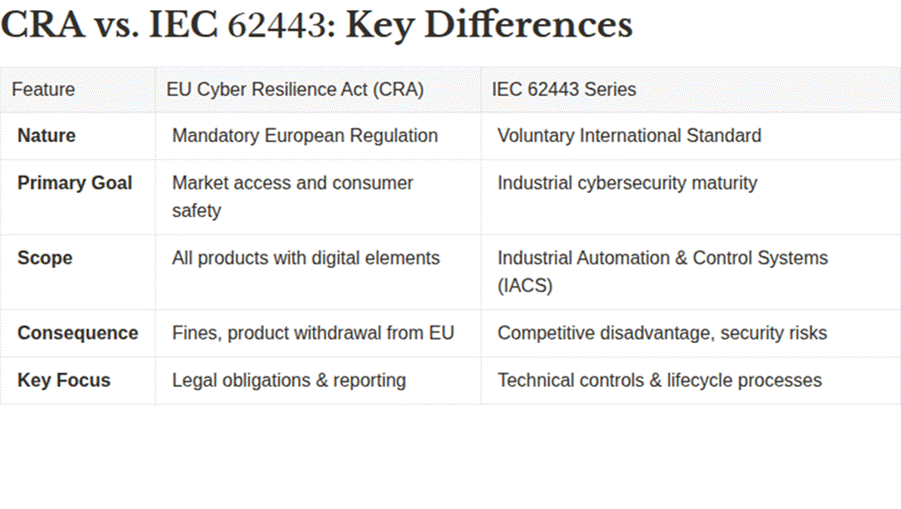
A common misunderstanding is that CRA introduces entirely new cybersecurity concepts not present in IEC 62443. In reality, there is significant overlap in the technical practices. The key difference lies not in the existence of these security practices, but in their role and legal standing.
Under IEC 62443:
Security practices are part of a cybersecurity framework. Organizations may adopt them to improve product security or demonstrate cybersecurity maturity.
Under CRA:
Certain cybersecurity practices become regulatory obligations. Manufacturers must be able to demonstrate compliance through documented evidence, processes, records, and conformity assessment activities.
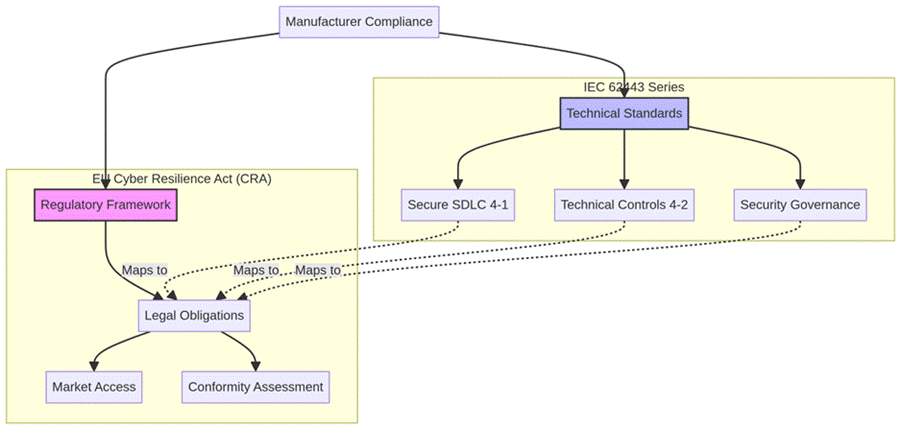
In essence, IEC 62443 helps organizations understand how to build cybersecurity capabilities, while CRA determines which capabilities must exist and what evidence is required to demonstrate compliance.
CRA vs. IEC 62443: Key Differences
A More Practical View
For organizations preparing for CRA, the most effective approach typically involves a multi-step process:
- Assess products against CRA requirements, particularly Article 13, Article 14, Annex I, and Annex VII2. The final regulation (EU) 2024/2847 outlines these in detail3 .
- Use established frameworks such as IEC 62443, NIST SSDF, BSI Technical Guidelines, and related industry practices to support implementation.
- Build the necessary technical controls, governance processes, and compliance evidence required by the Regulation.
This approach helps organizations avoid treating CRA as merely another cybersecurity standard, while still leveraging mature frameworks that already exist. The European Union Agency for Cybersecurity (ENISA) also provides studies mapping existing standards to CRA requirements, analyzing coverage and identifying gaps4.
Relationship between CRA and IEC 62443
Conclusion
IEC 62443 and CRA are not competing requirements, nor are they interchangeable. A more accurate understanding is that CRA defines what must be achieved from a regulatory perspective, and IEC 62443 provides a structured framework for helping organizations achieve it.
Therefore:
- ❌ IEC 62443 compliance does not automatically mean CRA compliance.
- ✅ IEC 62443 can be one of the most valuable foundations for CRA readiness.
As CRA implementation continues to evolve, organizations that understand this distinction will be better positioned to build sustainable compliance programs rather than simply pursuing another certification exercise.
Not Sure What to do?
Read our services information and request a free initial consultation or product assessment.
Our experts are here to help.
References
- European Commission – Cyber Resilience Act: https://digital-strategy.ec.europa.eu/en/policies/cyber-resilience-act ↩
- Regulation (EU) 2024/2847 of the European Parliament and of the Council (Cyber Resilience Act): https://eur-lex.europa.eu/eli/reg/2024/2847/oj/eng ↩
- CEN-CENELEC Webinar ‘CRA Standards Unlocked: From EN IEC 62443 to CRA’: https://www.cencenelec.eu/news-events/events/2025/2025-09-09-en-iec-62443-to-cra/ ↩
- ENISA – Cyber Resilience Act Requirements Standards Mapping: https://www.enisa.europa.eu/publications/cyber-resilience-act-requirements-standards-mapping ↩