


【India ISI】India BIS Footwear Labeling Guide: ISI Mark Compliance Checklist

As India continues to enforce BIS certification (ISI Mark) for over 27 categories of footwear, ensuring your packaging meets the latest standards is critical for market access. These regulations focus on stringent quality control and material safety to protect consumers.

Use this checklist to ensure your packaging labels are 100% compliant before shipping:

1. General Labeling Specifications

  • Placement: The ISI mark and required details must be prominently displayed on the individual product box.
  • Durability: All markings must be legible and indelible (resistant to fading or removal).
  • Font Size: To meet regulatory visibility standards, a minimum font size of Arial 6 is required.

2. Mandatory Information Checklist

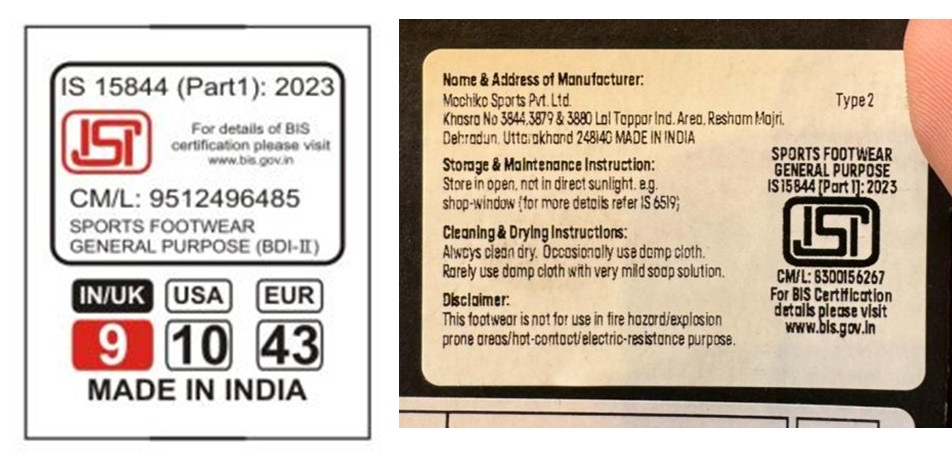
Each label must include the following four elements:

  1. License Number: Your unique BIS-assigned number (e.g., CM/L-XXXXXXX).
  2. Date of Manufacture: Clearly stated month and year of production.
  3. Manufacturer Details: Full legal name and physical address of the manufacturing facility.
  4. Official BIS Disclaimer: The following specific text must be included: “For BIS Certification details please visit www.bis.gov.in”.

Example label as below:
💡 Pro-Tip from THE ONE for Exporters

Failure to include the correct CM/L number or the mandatory website disclaimer is one of the most common reasons for customs delays in India. We recommend a pre-shipment label audit to ensure all technical specifications meet the BIS Footwear Quality Control Order (QCO) requirements.


For further inquiries, please contact:
Email:Charles.liao@theonelab.co
Phone:(02)8601-2828
BIS

【India BIS】India BIS Issues 2026 Conformity Assessment Amendment

On February 25, 2026, the Government of India published the Bureau of Indian Standards (Conformity Assessment) Amendment Regulations, 2026. This amendment introduces significant changes to fee payment structures, licence maintenance, and validity periods, affecting all manufacturers holding or seeking BIS certification.

1. Transition to “Annual Advance Payment” System 

The new regulations mandate that fees for the grant, renewal, and maintenance of licences must be paid annually in advance before the due date.

Crucially, the Production Statement must now be submitted simultaneously with the annual fee payment.

2. Stringent Penalties: Automatic Suspension and Cancellation 

BIS has implemented a more rigorous enforcement mechanism for non-compliance with payment schedules:

  • Immediate Suspension: Failure to pay by the due date will result in an automatic 90-day suspension of the licence.
  • Reinstatement Fee: To revoke a suspension, the licensee must pay the outstanding dues plus a late fee of INR 5,000.
  • Removal of Notice Period: For suspensions or cancellations caused by non-payment, the standard 21-day prior notice period no longer applies.

3. Extension of Licence Validity 

To streamline administrative processes, the initial grant and subsequent renewal periods for licences under Scheme-I, Scheme-II, and Scheme-X have been extended to a maximum of 5 years.

4. “Scheme-II”: A Registration Process Based on Self-Declaration

This amendment provides a detailed definition of Scheme-II (the registration system based on a self-declaration of conformity):

  • Process Transparency: Manufacturers must designate a third-party laboratory to conduct testing and submit a self-declaration of conformity for registration.
  • Market Surveillance: BIS reserves the right to draw samples from the market or customs at any time for surveillance testing.
  • Electronic Labelling (E-labelling): For electronic products with integrated displays, the use of electronic labels is permitted in place of physical labels.

For manufacturers with production facilities located outside India, please ensure that your Authorized Indian Representative (AIR) has signed the latest compliance declarations and affidavits to remain in full accordance with the updated regulatory requirements. 


For further inquiries, please contact:
Email:Charles.liao@theonelab.co
Phone:(02)8601-2828

BIS

【India BIS】India BIS Amends Scheme I Regulations: Automatic Licence Suspension for Electrical Appliances

For manufacturers exporting household and similar electrical appliances to the Indian market, ensuring product compliance with the IS 302 (Part 1): 2008 safety standard is the core of obtaining BIS certification. With the implementation of the 2026 Conformity Assessment (Amendment) Regulations, enterprises must pay close attention to changes in administrative procedures in addition to technical compliance.

I. Technical Level: Core Requirements of the IS 302-1 Safety Standard

IS 302 (Part 1) is the fundamental regulation for electrical safety in India, covering single-phase appliances with a rated voltage not exceeding 250V.

  • Testing Scope: Includes protection against electric shock, starting power consumption and current, resistance to humidity, overload protection, stability, mechanical hazards, and construction inspection.
  • Applicable Products: Household appliances such as rice cookers, electric water heaters, vacuum cleaners, and electric irons.
  • Mandatory Labeling: Products must be marked with the “Standard Mark” and clearly display the rated voltage, power consumption, manufacturer name, and country of origin.

II. Administrative Level: Major Changes in 2026 BIS Regulations

According to the latest government gazette published on February 25, 2026, the license management mechanism has undergone significant adjustments. Manufacturers are urged to take note of the following:

  • Significant Extension of License Validity: For household appliance products, the initial grant and subsequent renewals of BIS licenses (Scheme-I/CRS) can now be applied for a duration of up to 5 years, greatly reducing the administrative burden of frequent renewals.
  • “Annual Advance Payment” System for Fees: All fees required to maintain the validity of the license must be paid annually in advance. Manufacturers who fail to pay the fees and submit the “Production Statement” before the deadline will face an automatic 90-day license suspension.
  • Removal of Buffer Notification: The new regulation abolishes the 21-day notice period previously given before a suspension due to non-payment. If the fees remain unpaid at the end of the suspension period, the license will be directly cancelled.
  • MSME and Startup Incentives: Manufacturers qualified as MSMEs (Micro, Small, and Medium Enterprises) or Start-ups can apply for a fee reduction of up to 80% (valid until May 2029).

III. Expert Compliance Recommendations

Special reminders for manufacturers with production facilities located outside of India:

  • AIR (Authorized Indian Representative): Ensure that your AIR has signed the latest version of the compliance statement and affidavit.
  • Early Preparation: It is recommended to begin annual fee settlements and production data consolidation three months prior to the license expiry date to avoid license invalidation caused by technical delays.


For further inquiries, please contact:

Email:Charles.liao@theonelab.co

Phone:(02)8601-2828

【India ITSAR】Streamlines Telecom Certification: New Flexibility for Software Changes to Speed Up Product Launches


The National Centre for Communication Security (NCCS) in India has issued a landmark circular (No. 1-11/2022-NCCS/ComSec/V-I) dated March 17, 2026, aimed at streamlining the testing process under the Communication Security (ComSec) Scheme.
The release of this document signifies a shift towards a more pragmatic and flexible approach in India’s telecom security auditing.


1. Core Change: Flexibility for Software Modifications during Testing

Previously, software versioning was strictly locked once the testing phase began. The National Centre for Communication Security (NCCS) has now officially permitted applicants to modify the software of a Device Under Testing (DUT) while it is still within the Telecom Security Testing Laboratory (TSTL) process.

2. Mandatory Documentation for Modifications

To leverage this new flexibility, manufacturers must categorize their changes into two compliance paths:

  1. Code-Level Modifications: Requires the submission of Annexure-I & II, including a comprehensive Impact Assessment to ensure that the integrity of prior testing remains intact.
  2. Clerical Corrections: Requires only Annexure-II to rectify typos or minor descriptive errors in the Bill of Materials (BOM).

3. Strategic Impact

  • Reduced Lead Time: Eliminates the need to restart the entire application process for minor software adjustments.
  • Cost Efficiency: Minimizes redundant testing fees and resource allocation.
  • Agile Compliance: Allows OEMs to fix security vulnerabilities or bugs discovered during the testing phase in real-time.

4. Applicability

This notification applies to all stakeholders involved in the Indian Communication Security Certification Scheme (ComSec Scheme), including:

  • Original Equipment Manufacturers (OEMs)
  • Dealers and Importers
  • Telecom Security Testing Laboratories (TSTLs)

For further inquiries, please contact:
Email:Charles.liao@theonelab.co
Phone:(02)8601-2828

BIS

【India】BIS to Replace IS 13252-1 with IS/IEC 62368-1 Effective November 1, 2028

The Ministry of Electronics and Information Technology (MeitY), Government of India, has officially announced the transition of Indian safety standards IS 13252 (Part 1): 2010 and IS 616:2017 to IS/IEC 62368 (Part 1), as published in the Gazette of India.

According to the notification, IS/IEC 62368-1 has been adopted as the primary safety standard for Audio/Video, Information and Communication Technology (AV/ICT) equipment under the Electronics and Information Technology Goods (Requirement of Compulsory Registration) Order, 2021.

To facilitate a smooth transition for the industry, the Government of India has permitted the concurrent applicability of IS 13252-1, IS 616, and IS/IEC 62368-1 until November 1, 2028. After this date, IS 13252 (Part 1): 2010 and IS 616:2017 will be formally withdrawn, and BIS CRS registrations must comply exclusively with IS/IEC 62368-1.

The transition also applies to newly regulated product categories, including Extended Reality (XR) products, such as Augmented Reality (AR), Virtual Reality (VR), and Mixed Reality (MR) devices.

IS/IEC 62368-1 is based on the Hazard-Based Safety Engineering (HBSE) approach and has become the globally recognized safety standard for AV and ICT equipment. This migration aligns India’s BIS certification framework more closely with international IEC standards and supports global manufacturers in harmonizing product safety compliance across markets.

Manufacturers and brand owners are advised to begin evaluating product designs, test reports, and BIS certification strategies well in advance to ensure compliance with the post-2028 regulatory requirements.

For further inquiries, please contact:
Email:Charles.liao@theonelab.co
Phone:(02)8601-2828

TEC

【India TEC】India NCCS Extends Pro-Tem Security Certification to a Two-Year Validity (Effective Jan 1, 2026)

Key Update from DoT/NCCS: Scheme Extension and Certificate Validity Upgrade

Based on the latest official communications released by India’s Department of Telecommunications (DoT) and the National Centre for Communication Security (NCCS), the Pro-Tem Security Certification Scheme has been extended for an additional two (2) years effective from January 1, 2026. In parallel, the validity of individual Pro-Tem certificates has been increased from six (6) months to two (2) years. The policy is intended to provide the industry with greater operational certainty and sufficient transition time while formal security testing and certification activities continue under the national framework.

Scope: ITSAR-Mandated Products Remain In-Scope

The Pro-Tem certification continues to be closely aligned with the Indian Telecommunication Security Assurance Requirements (ITSAR). In practice, it primarily applies to regulated product categories such as IP Routers and Wi-Fi CPE (including routers, Wi-Fi access points/CPE devices, and related variants). Importantly, the extended validity should not be interpreted as an exemption from security compliance obligations. Instead, it is a mechanism to support market continuity while products undergo required testing and certification procedures.

Official Rationale: Business Continuity and Reduced Renewal Burden

NCCS has emphasized that the adjustment aims to: ensure continuity of business operations, reduce pressure caused by frequent renewals, and ease the transition toward full-scale mandatory security certification. For products already holding a Pro-Tem certificate, stakeholders are advised to track certificate status and any renewal/extension requirements through NCCS/MTCTE processes and subsequent notices, particularly where import clearance, delivery timelines, or customer commitments depend on valid certification status.

Ongoing Monitoring and Customer Advisory

Our team will continue to monitor further announcements and implementation guidance from DoT/NCCS, including any follow-up notifications, procedural clarifications, and updates related to the Pro-Tem pathway and subsequent standard/graded certification regimes. We will keep customers and partners informed as additional details become available.


TEC

【TEC-India-Ai Server】 The ONE Supports a Leading Taiwanese OEM in Securing India TEC Certification

Enabling AI Server Market Entry and Reducing Customs Clearance Uncertainty in India

The ONE today announced that it has successfully supported a leading Taiwanese OEM in obtaining India’s TEC certification for its AI server products—accelerating market entry into India and strengthening compliance readiness for stable shipments and smoother customs clearance. As India’s demand for ICT infrastructure and data center deployment continues to grow, Taiwan’s AI server supply chain is expanding globally while facing increasingly complex market-access and import compliance requirements.

AI Server Architectures Involving Switch Systems Increase Import Scrutiny

In many cases, traditional server products may not be subject to mandatory certification. However, modern AI server architectures typically incorporate high-speed interconnect designs between CPUs and GPUs, often involving switch systems that enable switching functionality. During importation, such components may raise concerns at customs due to regulatory considerations around switch-related items, potentially leading to additional inspection, document requests, or clearance delays. To avoid delivery risks caused by differing interpretations, The ONE worked closely with the customer to implement a proactive compliance strategy—preparing the required technical documentation, aligning test and evaluation plans, and managing the overall TEC application process. As a result, the customer secured certification to help ensure more predictable clearance and delivery timelines.

Addressing Non-Scale Out System Challenges with Speed and Execution Discipline

This project also covered a new Non-Scale Out system, which introduced multiple practical challenges across test conditions and certification workflows compared with conventional approaches. The ONE collaborated with its India-based partners and engaged in intensive, ongoing communications with TEC to clarify applicability, evidence expectations, and documentation positioning. By maintaining a high-efficiency project cadence and clear milestone control, The ONE successfully met the strict timeline requirements expected by a world-class brand.

Continuing to Strengthen Cross-Border Compliance Services for Taiwan’s AI Supply Chain

The ONE will continue investing in international regulatory research and cross-border compliance enablement, helping more Taiwanese manufacturers enter overseas markets with greater speed and confidence—so Taiwan’s AI supply chain can scale globally with stronger trust, resilience, and execution capability.


For further inquiries, please contact:
Email:Charles.liao@theonelab.co
Phone:(02)8601-2828

TEC

【India_TEC】 India NCCS Updates ITSAR: Wi-Fi CPE and IP Router V2.0.0 Released; Cloud-Implemented Exemption Extended to 31 Mar 2026

Highlights

India’s National Centre for Communication Security (NCCS) has released ITSAR V2.0.0 for Wi-Fi CPEs and IP Routers (Release date: 01 Dec 2025). These updated requirements serve as a key reference for product security alignment, documentation preparation, and compliance planning for suppliers targeting the Indian market.

Key 2026 Milestone

In an official memorandum dated 07 Jul 2025, NCCS confirmed that the exemption from security testing/certification for cloud-implemented IP Routers and Wi-Fi CPEs has been extended until 31 March 2026. Stakeholders are advised to treat this date as a major planning checkpoint and to accelerate internal readiness activities to minimize schedule and supply-chain risks beyond the exemption window.

Recommended Actions

  • Confirm product classification (Wi-Fi CPE vs. IP Router) and deployment model (including cloud-implemented architectures).
  • Perform a gap assessment against ITSAR 2.0.0, updating security design, evidence packages, and test plans accordingly.
  • Build a 2026 execution roadmap aligned to the exemption end date (31 Mar 2026), including certification lead times and procurement commitments.

Sources (Official NCCS Documents)

https://nccs.gov.in/public/circulars_sc/ExtensionOfMandatoryDateForCloudRouterCPE.pdf

https://nccs.gov.in/public/latest_updates/ITSAR402122512.pdf

https://nccs.gov.in/public/latest_updates/ITSAR201012512.pdf